29 mai 1990 — La naissance d’une aventure musicale avec Ludovic-Amadeus Selmi
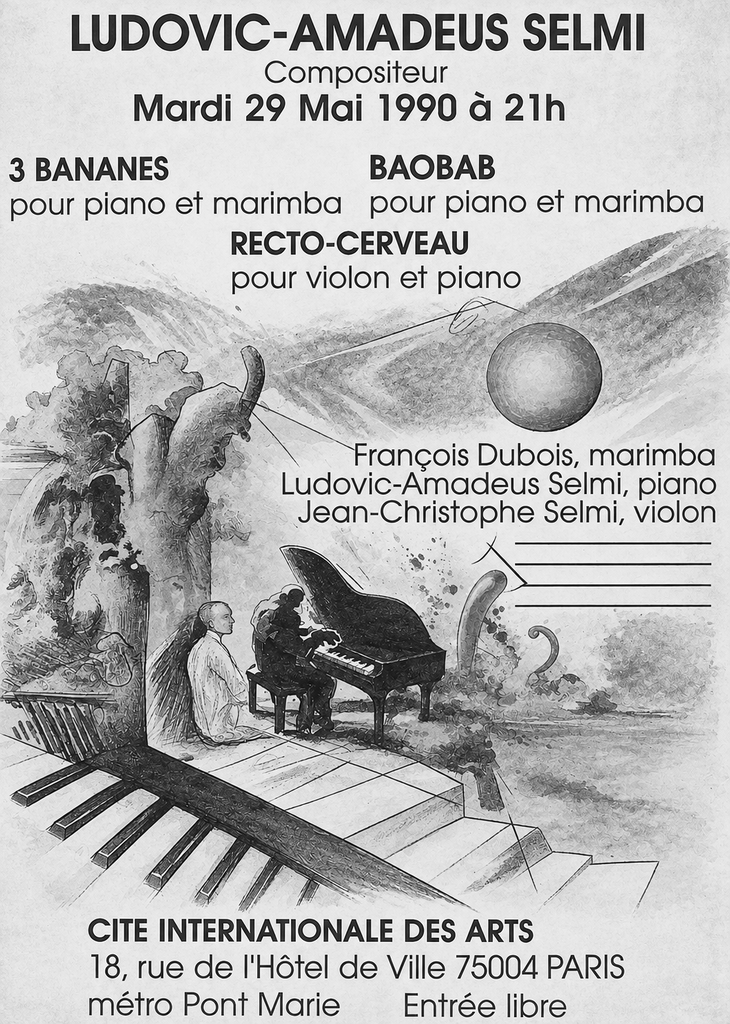
Il est des rencontres musicales qui, avec le recul, prennent une importance toute particulière dans un parcours artistique. Ce concert du mardi 29 mai 1990, à la Cité Internationale des Arts, à Paris, fait partie de ces moments fondateurs.
C’est l’un des premiers concerts que j’ai donnés avec le pianiste et compositeur Ludovic-Amadeus Selmi. Peut-être même le premier, bien que le temps ait quelque peu estompé l’ordre exact de nos débuts. Ce dont je me souviens, en revanche, c’est qu’il allait être le point de départ d’une belle aventure musicale.
Nous avions choisi de présenter deux œuvres en création mondiale : 3 Bananes et Baobab, toutes deux écrites pour piano et marimba. Deux pièces qui marquaient le début d’un travail commun autour de ces deux instruments, dont les timbres, les couleurs et les possibilités de dialogue allaient progressivement constituer notre identité musicale.
Pour cette occasion, Ludovic avait également invité son frère, le violoniste Jean-Christophe Selmi, à nous rejoindre. Le programme comprenait ainsi une troisième œuvre, Recto-Cerveau, pour violon et piano. Cette présence apportait une autre dimension à la soirée, en ouvrant notre rencontre musicale à une formation différente.
Mais ce concert n’était que le commencement.
Nous allions ensuite parcourir ensemble les routes de France et d’Europe, multiplier les concerts et partager de nombreuses expériences artistiques. En 1991, notre aventure nous conduirait même jusqu’au Japon. Une destination qui allait prendre, dans les années suivantes, une place considérable dans mon histoire personnelle et musicale.
Il y a aussi une anecdote que j’aime particulièrement raconter à propos de cette affiche.
Sa réalisation avait été confiée à un artiste sud-américain qui avait imaginé une illustration très singulière, dans laquelle il avait dissimulé sa propre signature. Il ne s’agissait pas simplement de signer son œuvre, mais de cacher son nom dans le dessin, au point que très peu de personnes étaient capables de le retrouver. C’était précisément son intention : faire de la découverte de sa signature une sorte de jeu, presque un secret réservé aux regards les plus attentifs.
Aujourd’hui encore, cette affiche conserve quelque chose de mystérieux et de vivant. Elle témoigne d’une époque, d’une rencontre et d’une certaine liberté créative, lorsque musiciens et artistes partageaient le désir de faire naître des projets sans nécessairement savoir jusqu’où ils les conduiraient.
En regardant cette affiche, je ne vois donc pas seulement l’annonce d’un concert parisien de 1990. J’y retrouve le début d’une complicité musicale, la naissance d’un duo marimba-piano et les premiers pas d’un voyage artistique qui allait nous mener bien au-delà de cette soirée.
Certaines aventures commencent discrètement. On ne sait pas encore qu’elles vont durer, ni les chemins qu’elles vont ouvrir. On joue simplement ensemble, avec conviction, curiosité et enthousiasme.
Celle-ci avait commencé le 29 mai 1990, à Paris.
English
May 29, 1990 — The Beginning of a Musical Adventure with Ludovic-Amadeus Selmi
Some musical encounters take on a very special significance when viewed in retrospect. The concert held on Tuesday, May 29, 1990, at the Cité Internationale des Arts in Paris, was one of those defining moments.
It was one of the first concerts I performed with pianist and composer Ludovic-Amadeus Selmi. Perhaps even the very first, although time has somewhat blurred the exact chronology of our beginnings. What I do remember clearly, however, is that it marked the starting point of a wonderful musical adventure.
For this occasion, we presented two world premieres: 3 Bananes and Baobab, both written for piano and marimba. These two compositions marked the beginning of our shared exploration of the instruments’ respective colours, timbres and expressive possibilities, gradually shaping the musical identity of our piano-marimba duo.
Ludovic had also invited his brother, violinist Jean-Christophe Selmi, to join us for the concert. The programme therefore included a third work, Recto-Cerveau, for violin and piano. His participation brought another dimension to the evening, opening our musical encounter to a different instrumental combination.
But this concert was only the beginning.
We would subsequently travel together throughout France and Europe, performing concerts and sharing countless artistic experiences. In 1991, our musical journey would even take us to Japan, a country that would later occupy a particularly important place in my personal and musical life.
There is also a little anecdote about this poster that I have always enjoyed telling.
Its illustration was created by a South American artist who had imagined a rather unusual composition. He had carefully hidden his own signature somewhere within the drawing. Rather than simply signing his work, he had chosen to conceal his name so cleverly that very few people were able to find it. That was precisely his intention: to turn the discovery of his signature into a little game, almost a secret reserved for the most attentive observers.
Even today, this poster retains something mysterious and full of life. It captures the spirit of an era, an encounter and a certain creative freedom, when musicians and artists shared the desire to bring new projects to life without necessarily knowing how far they would eventually lead.
When I look at this poster, I no longer see merely the announcement of a Paris concert in 1990. I see the beginning of a musical partnership, the birth of a piano-marimba duo and the first steps of an artistic journey that would take us far beyond that evening.
Some adventures begin quietly. We do not yet know how long they will last or which paths they will open. We simply play together, with conviction, curiosity and enthusiasm.
Ours began on May 29, 1990, in Paris.
Español
29 de mayo de 1990 — El comienzo de una aventura musical con Ludovic-Amadeus Selmi
Hay encuentros musicales que, vistos con la perspectiva del tiempo, adquieren un significado muy especial. El concierto celebrado el martes 29 de mayo de 1990 en la Cité Internationale des Arts de París fue uno de esos momentos decisivos.
Fue uno de los primeros conciertos que ofrecí junto al pianista y compositor Ludovic-Amadeus Selmi. Quizás incluso el primero, aunque el paso del tiempo ha difuminado un poco el orden exacto de nuestros comienzos. Lo que sí recuerdo con claridad es que aquella actuación marcó el inicio de una hermosa aventura musical.
Para aquella ocasión presentamos dos obras en estreno mundial: 3 Bananes y Baobab, ambas escritas para piano y marimba. Estas composiciones marcaron el comienzo de un trabajo compartido en torno a los dos instrumentos, sus timbres, sus colores y sus posibilidades expresivas. Poco a poco, ese diálogo musical iría dando forma a la identidad de nuestro dúo de marimba y piano.
Ludovic había invitado también a su hermano, el violinista Jean-Christophe Selmi, a participar en el concierto. El programa incluía así una tercera obra, Recto-Cerveau, para violín y piano. Su presencia aportó otra dimensión a aquella velada, ampliando nuestro encuentro musical hacia una formación instrumental diferente.
Pero aquel concierto no era más que el comienzo.
Después recorreríamos juntos las carreteras de Francia y Europa, ofreciendo conciertos y compartiendo numerosas experiencias artísticas. En 1991, nuestra aventura musical nos llevaría incluso hasta Japón, un país que más adelante ocuparía un lugar muy importante en mi vida personal y musical.
Hay también una pequeña anécdota relacionada con aquel cartel que siempre me ha gustado contar.
La ilustración fue realizada por un artista sudamericano que imaginó una composición muy singular. Había escondido cuidadosamente su propia firma en algún lugar del dibujo. En lugar de limitarse a firmar su obra, decidió ocultar su nombre de tal manera que muy pocas personas fueran capaces de descubrirlo. Esa era precisamente su intención: convertir la búsqueda de su firma en una especie de juego, casi en un secreto reservado a las miradas más atentas.
Todavía hoy, aquel cartel conserva algo de misterio y vitalidad. Es testimonio de una época, de un encuentro y de cierta libertad creativa, cuando músicos y artistas compartían el deseo de dar vida a nuevos proyectos sin saber necesariamente hasta dónde podrían conducirlos.
Cuando miro aquel cartel, ya no veo simplemente el anuncio de un concierto parisino de 1990. Veo el comienzo de una complicidad musical, el nacimiento de un dúo de marimba y piano y los primeros pasos de un viaje artístico que nos llevaría mucho más allá de aquella velada.
Algunas aventuras comienzan discretamente. Todavía no sabemos cuánto durarán ni qué caminos abrirán. Simplemente tocamos juntos, con convicción, curiosidad y entusiasmo.
La nuestra comenzó el 29 de mayo de 1990, en París.
日本語
1990年5月29日 — リュドヴィック=アマデウス・セルミとの音楽の冒険の始まり
音楽家同士の出会いには、時を経て振り返ったとき、特別な意味を持つようになるものがあります。1990年5月29日火曜日、パリのシテ・アンテルナショナル・デ・ザールで開催されたこのコンサートは、まさにそのような節目のひとつでした。
ピアニストであり作曲家でもあるリュドヴィック=アマデウス・セルミと共演した、最初期のコンサートのひとつです。もしかすると最初のコンサートだったのかもしれませんが、私たちがどのような順序で活動を始めたのか、正確な記憶は少し曖昧になっています。しかし、この演奏会がひとつの素晴らしい音楽の冒険の出発点となったことは、今でもはっきりと覚えています。
この日のプログラムでは、ピアノとマリンバのために書かれた二つの作品、《3 Bananes》と《Baobab》を世界初演しました。この二作品は、二つの楽器が持つ音色や響き、表現の可能性を探求する共同作業の始まりでもありました。こうした対話を重ねながら、私たちのピアノとマリンバによるデュオ独自の音楽的な個性が、少しずつ形づくられていくことになります。
また、このコンサートには、リュドヴィックの弟でヴァイオリニストのジャン=クリストフ・セルミも招かれていました。プログラムには、ヴァイオリンとピアノのための《Recto-Cerveau》も加わり、異なる編成による音楽の広がりが、この夕べにもうひとつの彩りを添えてくれました。
しかし、このコンサートはまだ始まりにすぎませんでした。
その後、私たちはフランス各地、そしてヨーロッパ各地を共に巡り、数多くのコンサートを行いながら、さまざまな芸術的経験を分かち合っていきました。1991年には、私たちの音楽の旅は日本にまで及びます。日本はその後、私の人生と音楽活動において、非常に重要な場所となっていきました。
このポスターには、もうひとつ、私がとても気に入っているエピソードがあります。
イラストを手がけたのは南米出身のアーティストでした。彼は非常に独創的な絵を描き、その中に自分自身のサインを巧みに隠していたのです。単に作品に名前を記すのではなく、絵のどこかに自分の名前を忍ばせ、ほとんどの人が見つけられないようにしていました。それこそが彼の狙いでした。サインを探し出すこと自体を小さな遊びにし、注意深く絵を見る人だけがたどり着ける秘密にしたかったのです。
今見ても、このポスターには不思議な魅力と生命感が残っています。ひとつの時代、ひとつの出会い、そして自由な創造性を大切にしていた時代の空気を伝えてくれます。音楽家と芸術家が、そこからどこへ向かうのかをまだ知らないまま、新しい何かを生み出そうとしていた時代です。
このポスターを眺めるとき、私の目に映るのは、1990年のパリで開かれた一回のコンサートの告知だけではありません。音楽的な信頼関係の始まり、マリンバとピアノのデュオの誕生、そしてあの夜をはるかに超えて続いていく芸術の旅の第一歩なのです。
大きな冒険は、静かに始まることがあります。それがどれほど長く続くのか、どのような道を開いていくのか、そのときにはまだ誰にもわかりません。ただ、確信と好奇心、そして情熱を持って、一緒に演奏するのです。
私たちの冒険は、1990年5月29日、パリで始まりました。
中文
1990年5月29日——与 Ludovic-Amadeus Selmi 音乐之旅的起点
有些音乐家之间的相遇,随着岁月流逝,回过头来才会发现它具有格外重要的意义。1990年5月29日星期二,在巴黎国际艺术城(Cité Internationale des Arts)举行的这场音乐会,正是这样一个值得铭记的时刻。
这是我与钢琴家、作曲家 Ludovic-Amadeus Selmi 合作演出的最早几场音乐会之一。也许就是我们的第一次合作演出,尽管时间已经让我有些记不清最初的确切顺序。但我清楚地记得,这场音乐会成为了一段美好音乐旅程的起点。
当晚,我们带来了两首世界首演作品:《3 Bananes》和《Baobab》,两首作品均为钢琴与马林巴而作。这两部作品也标志着我们共同探索这两种乐器音色、声音层次以及表现可能性的开始。随着合作的深入,钢琴与马林巴之间独特的音乐对话,逐渐形成了我们二重奏的艺术风格。
此外,Ludovic 还邀请了他的弟弟、小提琴家 Jean-Christophe Selmi 一同参加这场音乐会。因此,演出曲目中还包括第三首作品《Recto-Cerveau》,为小提琴与钢琴而作。他的加入为这个夜晚增添了另一种音乐维度,也让这次相遇呈现出不同的器乐组合。
然而,这场音乐会仅仅是一个开始。
此后,我们一起走过法国和欧洲的许多地方,举办音乐会,分享了无数艺术经历。1991年,我们的音乐之旅甚至延伸到了日本。后来,日本逐渐成为我个人生活和音乐事业中一个极其重要的地方。
关于这张海报,还有一个我一直很喜欢讲述的小故事。
海报的插画出自一位南美艺术家之手。他创作了一幅非常独特的画,并将自己的签名巧妙地隐藏在画面之中。他并没有简单地在作品上署名,而是把自己的名字藏在图画的某个角落,让绝大多数人都无法轻易找到。这正是他的创作意图:让寻找签名本身成为一种游戏,成为一个只有观察得足够仔细的人才能发现的小秘密。
直到今天,这张海报依然保留着一种神秘而鲜活的魅力。它记录了一个时代、一次相遇,也记录了一种自由的创作精神。在那个时期,音乐家与艺术家怀着共同的愿望,希望创造新的作品,却未必知道这些尝试最终会把他们带向何方。
如今,当我再次凝视这张海报时,我看到的已经不仅仅是1990年巴黎一场音乐会的演出预告。我看到的是一段音乐默契的开始,是马林巴与钢琴二重奏的诞生,也是一次艺术旅程的第一步——一段后来远远超越了那个夜晚的旅程。
有些冒险,往往是在不经意间悄然开始的。那时,我们还不知道它会持续多久,也不知道它将为我们开启怎样的道路。我们只是怀着坚定、好奇与热情,一起演奏。
我们的这段旅程,始于1990年5月29日,巴黎。